








Stay Current PSA Newsroom
November 17, 2026
How to Become an Aircraft Maintenance Technician
Aircraft maintenance technicians perform the inspections, troubleshooting, repairs, and documentation that keep aircraft airworthy and ready for service. For people who enjoy mechanical problem-solving and hands-on work, aviation maintenance can offer a direct path into the airline industry.
Most people entering the field build a foundation through technical training, FAA certification, and practical experience. Some candidates attend an FAA-certificated Aviation Maintenance Technician School, while others qualify through documented work experience or certain military aviation maintenance pathways.
At PSA Airlines, maintenance professionals support an all-jet fleet of MHI RJ regional aircraft operating more than 700 daily flights to nearly 100 destinations on behalf of American Airlines. Working on that fleet requires technicians to follow detailed procedures, communicate clearly, and perform maintenance accurately.
What Does an Aircraft Maintenance Technician Do?
An aviation maintenance technician inspects, maintains, troubleshoots, and repairs aircraft and their systems. Depending on the assignment, that work may involve aircraft structures, engines, electrical systems, hydraulic systems, landing gear, flight controls, and other components.
Some maintenance is scheduled in advance, such as inspections or work required at specific intervals. Other tasks begin when a discrepancy is discovered during an inspection, reported by a flight crew, or identified through aircraft systems. Technicians use approved procedures and current maintenance information to determine what needs attention and how the work should be completed.
Every inspection, repair, or component change must be documented so there is a clear history of the work performed. Accurate records support FAA compliance and give other maintenance personnel useful information about the aircraft.
Choose an Aviation Maintenance Training Path
Aviation maintenance training builds the mechanical knowledge and practical skills needed to work on aircraft. One common option is an FAA-certificated Aviation Maintenance Technician School, where students receive classroom instruction along with hands-on experience with aircraft systems, tools, and maintenance procedures.
Coursework may cover aircraft structures, engines, electrical systems, inspections, troubleshooting, maintenance documentation, and the use of technical manuals and other approved information. Students learn to approach problems methodically instead of relying on guesswork.
Practical experience offers another way to qualify. Certain military aviation maintenance backgrounds may also lead toward FAA certification when the experience or training meets applicable requirements.
Program length varies by school and training path. Many aviation maintenance programs take about 18 to 24 months, while candidates qualifying through practical experience follow different FAA experience requirements.
Earn FAA Airframe and Powerplant Certification
PSA requires maintenance professionals to obtain an FAA Aviation Mechanic certificate with Airframe and Powerplant ratings, commonly called an A&P certificate. The Airframe rating covers aircraft structures and related systems, while the Powerplant rating covers engines and associated systems.
To qualify for FAA certification, applicants must be at least 18 years old and able to read, write, speak, and understand English. Candidates may qualify through an FAA-certificated Aviation Maintenance Technician School, qualifying practical experience, or applicable military training.
For candidates using practical experience, the FAA generally requires 18 months of experience for either the Airframe or Powerplant rating and 30 months for both ratings. Applicants must then pass FAA knowledge, oral, and practical tests, with the oral and practical portions administered by a Designated Mechanic Examiner.
Earning both Airframe and Powerplant ratings provides broad authorization to perform and approve many types of aircraft maintenance within the privileges of the certificate. PSA’s airline maintenance qualifications can help candidates see how those credentials fit into current maintenance roles.
Build Hands-On Experience
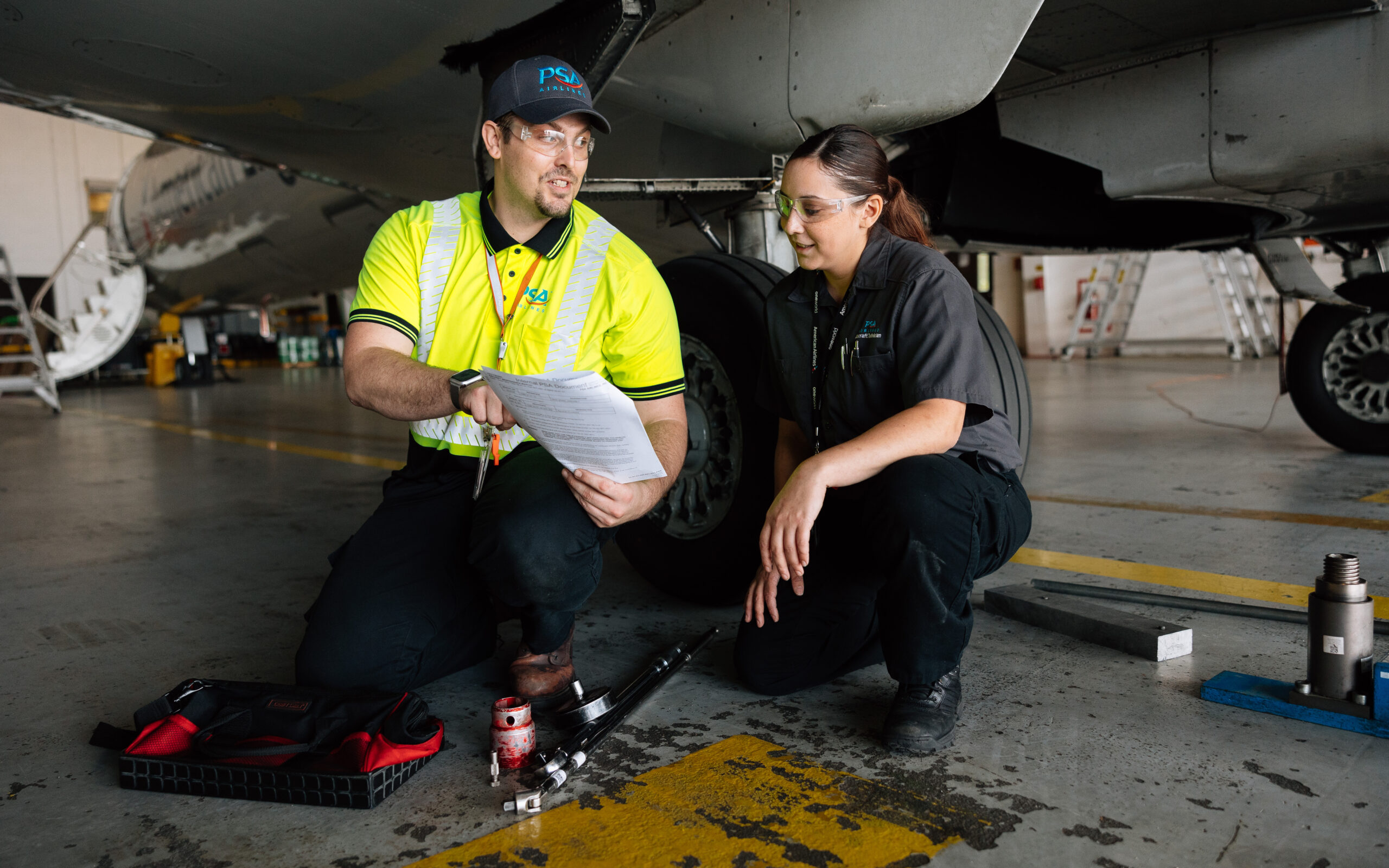
Hands-on experience gives technicians opportunities to apply what they learned in training to actual aircraft and maintenance situations. Tasks may involve inspecting components, using maintenance manuals, taking measurements, removing and installing parts, or troubleshooting a system that is not operating as expected.
With practice, technicians become more comfortable with tools and procedures while developing a better understanding of how aircraft systems interact. They also learn to recognize normal wear, identify findings that need further investigation, and locate the correct maintenance information for the task.
Experience gradually improves pattern recognition and troubleshooting efficiency. The goal is to understand what they are seeing, follow the required procedure, and document the work accurately.
Skills Aircraft Maintenance Technicians Need
Troubleshooting is central to aircraft maintenance. A technician needs to evaluate symptoms, review maintenance information, and work through possible causes carefully before deciding what needs attention.
Attention to detail is equally important because maintenance work involves precise procedures, measurements, inspections, and documentation. Small errors can have serious consequences.
Clear communication and teamwork help maintenance crews work effectively across shifts and departments. Technicians may coordinate with supervisors, planners, aviation parts specialists, quality personnel, and other technicians while using hand tools, measuring equipment, and other maintenance tools safely and correctly.
Aircraft Maintenance Technician Pay and Job Outlook
Pay varies by employer, location, experience, certification, and type of aviation work. According to the U.S. Bureau of Labor Statistics, aircraft mechanics and service technicians had a median annual wage of about $79,870 in May 2025.
BLS projects about 13,100 openings for aircraft and avionics equipment mechanics and technicians each year from 2025 to 2035. Those openings reflect both employment growth and the need to replace workers who leave the occupation.
Airframe and Powerplant certification can support opportunities in airline maintenance and other aviation settings because it demonstrates that a mechanic has met FAA knowledge and practical requirements for both ratings.
Start an Aircraft Maintenance Career with PSA Airlines
PSA Airlines supports an all-jet fleet of MHI RJ regional aircraft through 10 maintenance facilities across its network. For a new technician, PSA’s regional operation offers the chance to work with an active jet fleet and apply training in an airline maintenance setting.
For qualifying service members and veterans, PSA’s Maintenance Military Transition Program provides another option for moving relevant aviation maintenance experience into civilian airline work.
Whether you are beginning technical training, preparing for FAA certification, or bringing maintenance experience from another setting, PSA offers opportunities for candidates at different stages of an airline maintenance career. Review current PSA maintenance opportunities and qualifications to find the next step that fits your background.