




Stay Current PSA Newsroom
March 31, 2026
Women’s History Month: The woman who helps shape PSA’s flight deck
Women’s History Month asks us to look closely at the many ways women have shaped our industry — not only through visible milestones, but through the steady, intentional work that holds aviation together. Captain Amy Carson’s story offers a reminder that progress isn’t always loud. Sometimes, it’s built in simulator bays, checklists and standards that keep passengers safe and pilots prepared.
Even today, women remain a small fraction of airline pilots, a number that has grown slowly over the past two decades. But Amy’s career is living proof that visibility — paired with expertise — changes what feels possible.
Chasing her dream
For Captain Amy Carson, aviation has always been about possibility, long before she understood the path to the cockpit.
As a child, she dreamed of becoming an astronaut, captivated by what she saw on television and inspired by the boldness of exploration. There were pilots in her family too, including a great uncle who flew for Eastern Airlines, and the stories he told made aviation feel fascinating, even if it didn’t yet feel accessible.
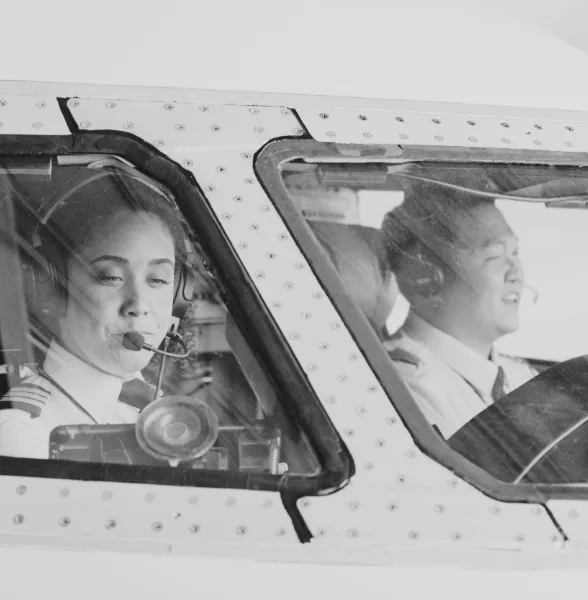
That clarity came later, during her time as a flight attendant with America West. One day, on a ferry flight, Amy stepped into the cockpit — and both pilots were women.
“That was the moment,” she recalls. “I remember thinking, this fits me.”
There was no formal leave of absence available for flight training, so Amy made a choice that would define her career. She quit her job and went to flight school.
Inside the simulator: Where standards are set
Amy’s journey eventually brought her to PSA, where she spent more than four years as a first officer before stepping into a role that expanded her impact well beyond the flight deck.
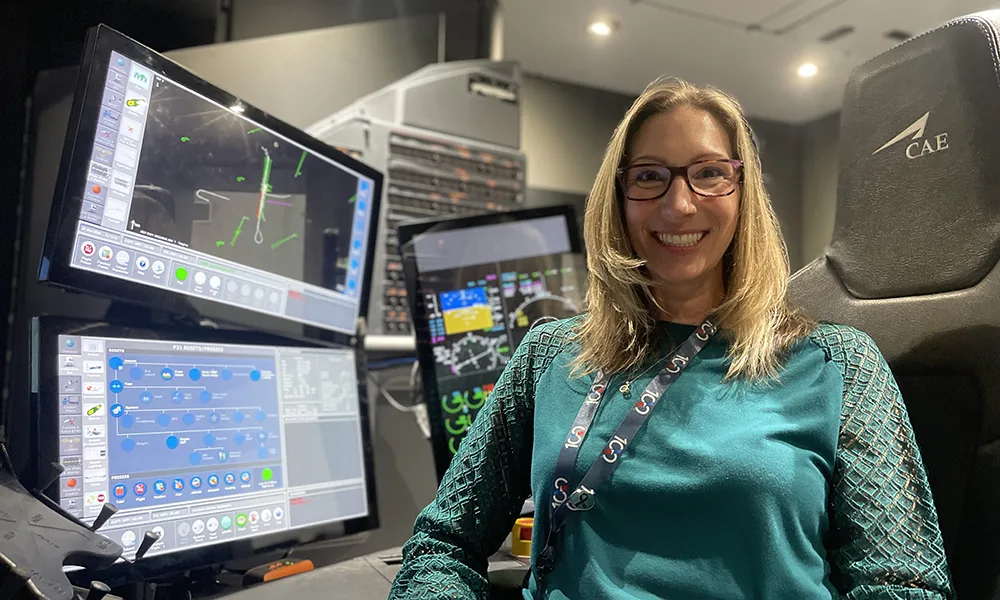
Today, she serves as a simulator instructor and Aircrew Program Designee (APD) — a role that carries significant responsibility and trust.
Becoming an APD requires years of experience, including line qualification, fleet expertise, captain qualification, hundreds of hours of pilot‑in‑command time, and service as both a simulator instructor and proficiency check airman.
“It’s a big responsibility that I take great pride in,” Amy explains. “When someone completes a checkride with me, I issue their Airline Transport Pilot certificate with the CL‑65 type rating. My name is on their license.”
That checkride marks the final evaluation before a pilot flies revenue passengers.
“If something happens later,” she added, “it comes back on me. So safety is everything.”
Training is about teaching — not catching mistakes
One of the most common misconceptions about simulator instructors, Amy said, is that the role is purely evaluative.
“We’re a training department,” she emphasized. “I want pilots to leave having learned something they can use every day.”
Training begins with simulator sessions focused on maneuvers, failures and profiles. From there, pilots move into Line Oriented Flight Training (LOFT) — full, point‑to‑point flights designed to replicate real‑world airline operations.
“That’s where we teach them how to be airline pilots,” Amy said.
Her approach in the sim is shaped by patience, approachability and a belief that learning often happens through mistakes — not by stepping in too quickly to fix them.
Motherhood further influenced that mindset. Amy said becoming a parent made her more patient and better able to meet people where they are — a quality that carries into every simulator session.
Why she stays
Today, Amy sees an industry evolving. Technology is advancing rapidly — from improved simulation to potential virtual training tools — and while pilot demand may fluctuate, one trend gives her confidence: more women are entering aviation.
Asked if her twin daughters, now 13, should pursue a path to the cockpit?
“I would absolutely encourage them,” Amy says without hesitation. “I love my job.”
What keeps her at PSA, she says, is the culture.
“The people care. There are hard days — we’ve been through tragedy — but if someone raises a concern, it’s taken seriously. That’s culture. And that’s why I stay.”
A quiet standard
Asked whether she thinks about her place in the legacy of women in aviation, Amy is candid.
“I don’t see myself as a woman in the cockpit — just a pilot,” she said. “I want to be here because I’m competent and working hard.”
It’s a perspective grounded in professionalism rather than recognition — and one that mirrors her approach every day. Inside the simulator, during checkrides and through the standards she helps enforce, Amy focuses less on visibility and more on responsibility.
The result is an influence felt by every pilot she trains — whether they know it or not.